
Five places to write one observation.
The service app, daily log, behavior log, 24-hour binder, and a pocket checklist all compete for the same few minutes.
AI documentation built for California assisted living. Care Managers and Med Techs capture observations by voice while they care; licensed nurses review survey-ready notes, and signed records reach the EHR before shift end.

Built around the assisted living floor
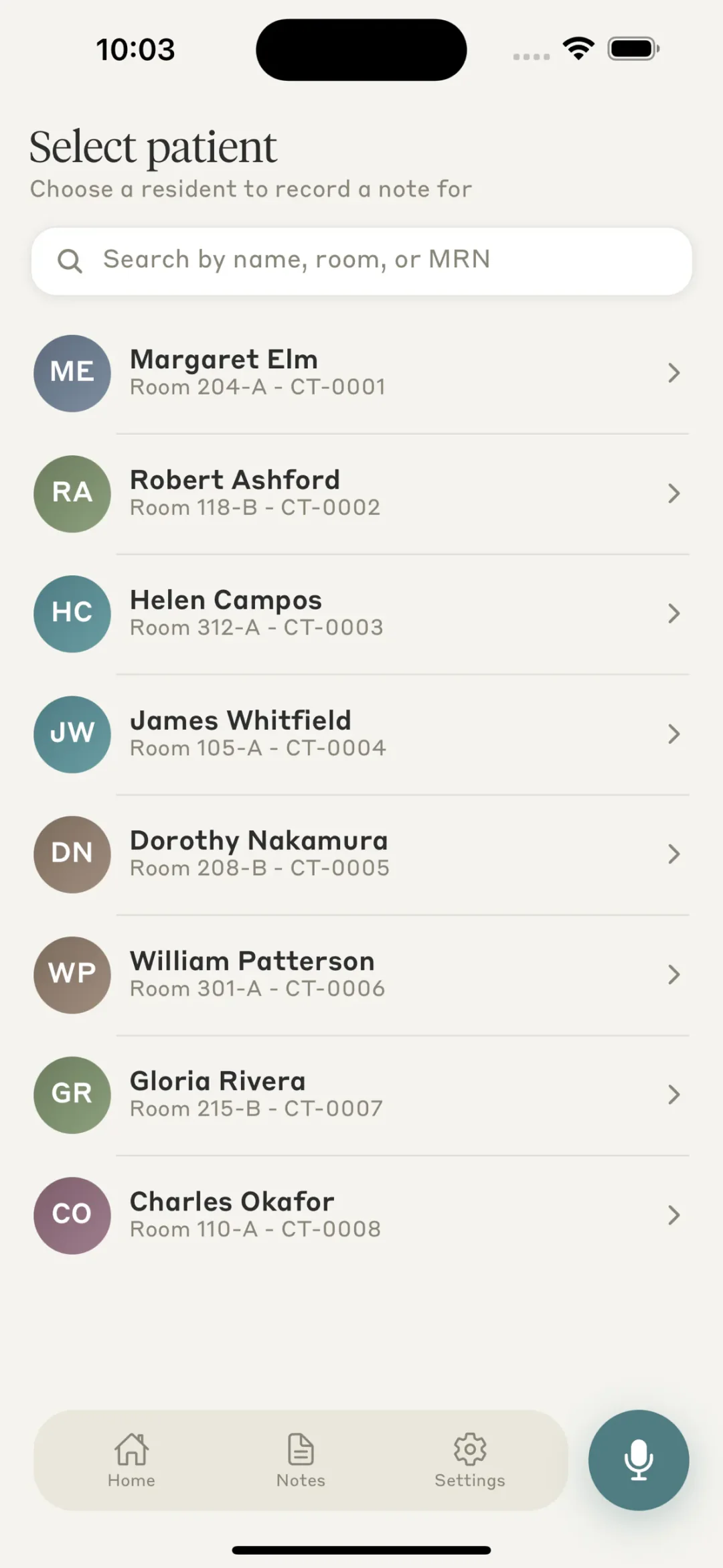
Your team dictates at the bedside. CareTrace writes shift notes, incident reports, and service plans into the EHR at a tap. Survey-ready.

Care Manager observation · change-of-condition flag attached
The handoff between care staff and nurses still runs on paper, walkies, verbal updates, and a shared binder. That is where observations get lost.
The service app, daily log, behavior log, 24-hour binder, and a pocket checklist all compete for the same few minutes.
Paper notes at the bedside become a second documentation job back at the desktop, between constant interruptions.
Seventeen sections, notification follow-up, and a backlog that grows while the nurse is still responsible for the floor.
Staff dictate at the bedside. Survey-ready, regulation-aware documentation lands in the EHR at a tap, before the shift ends.
A fall at 7:14. Spoken at the bedside, not queued for the end of the shift.
CareTrace structures the dictation into a survey-ready incident report. Regulation-aware, care plan updated, nothing retyped.
One tap into the EHR your community already runs, while staff are still on the floor. The paper-to-EHR gap closes inside the shift.
The same documentation repeats across every assisted living shift. CareTrace generates and formats each piece from bedside dictation before the shift ends.
Bedside observations become complete, review-ready LIC 624 drafts with the timeline, injury check, notifications, and follow-up captured for Title 22 §87211.
A meaningful change in condition can prompt the service-plan and reappraisal work the licensed team needs to review next.
ADLs, skin observations, refusals, behavior changes, and routine shift notes are dictated where the care happens instead of reconstructed later.
Every note is timestamped, reviewable, and structured around California Title 22 and the community's own documentation policy.
After licensed review, CareTrace files the signed note into the EHR your community already uses, without an end-of-shift retype.
CareTrace writes into any EHR you use.
Care observations and reviewed notes mapped to the fields your team already uses.
Shift documentation prepared for the resident record after licensed review.
The workflow is mapped during the pilot, without asking your team to replace its system.
And any other EHR your team already runs. We'll map it at pilot.
Protection is part of the documentation workflow, not an add-on after resident information has already moved.
CareTrace is voice-first AI documentation for California assisted living facilities. Care Managers and Med Techs speak observations as they work, a licensed nurse reviews the draft, and the signed note reaches the EHR before the shift ends.
Medical scribes are designed around a clinician visit. CareTrace is designed around an assisted living shift: many residents, care-staff observations, the 24-hour binder, licensed review, and California Title 22 documentation.
No. CareTrace works alongside the EHR your community already uses. It turns spoken observations into structured drafts, keeps licensed review in the loop, and files the signed note without creating a second chart for staff to maintain.
CareTrace is focused on California Residential Care Facilities for the Elderly, including assisted living and memory-care programs operating inside an RCFE.
Three steps: a Care Manager, Med Tech, or nurse speaks an observation; CareTrace structures it into the community's documentation format; and a licensed reviewer edits and signs it before it is filed into the EHR.
A bedside interaction typically produces a finalized note in under two minutes. Staff speak naturally; CareTrace structures the note to community policy and routes it to the EHR.
Yes. CareTrace signs a HIPAA Business Associate Agreement, keeps PHI in U.S. data residency, encrypts data in transit and at rest, and supports per-tenant audit logs. BAAs with sub-processors (AWS, Anthropic, AssemblyAI) are executed before any PHI is processed.
CareTrace encrypts all data in transit (TLS 1.2+) and at rest (AES-256). PHI is isolated per-tenant with row-level security in a U.S.-hosted database. Role-based access control limits who can view, edit, or export data. Every access event is logged for audit.
Qualifying California assisted living communities can run a pilot on a real shift. Your team dictates, reviews the generated documentation, and sees how it reaches the existing EHR before deciding on a rollout.
A pilot runs a single shift end-to-end: your staff dictates real documentation, CareTrace generates structured notes, and your Resident Care Director or DON reviews the output. No commitment beyond the pilot shift. Most teams decide within one shift whether CareTrace fits their workflow.
Start with one real shift. Your team speaks, reviews, and sees what reaches the EHR before anyone commits to a rollout.